Best Cordyceps Training Program: Beginner to Advanced
- Neeraj Kumar
- Jan 22
- 7 min read
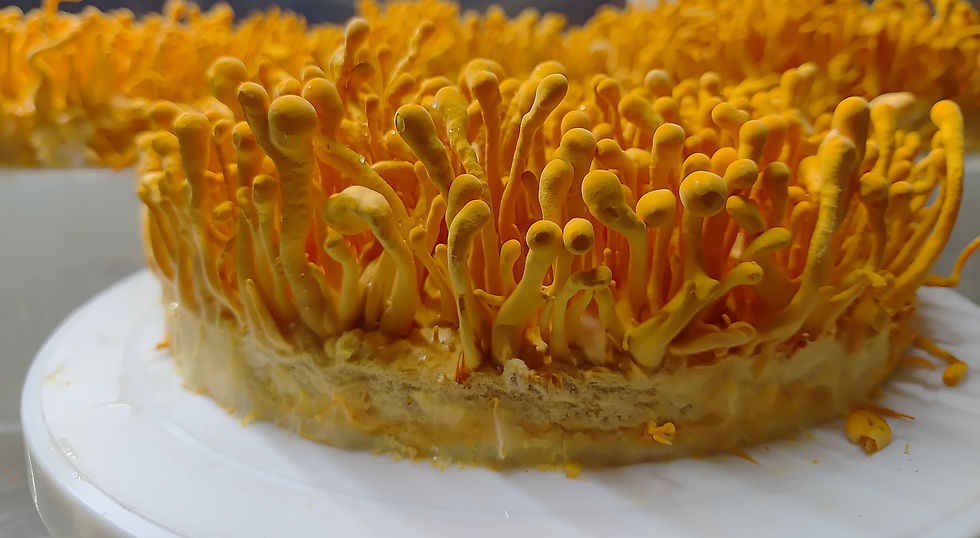
Cordyceps militaris is one of the most in-demand medicinal mushrooms today, valued for its premium market price and rapidly growing commercial potential. However, successful cultivation is not just about buying a culture and trying random online methods—it requires correct sterile practices, the right substrate formulation, correct selection and design of Cordyceps culture vessels, preparation and treatment of liquid spawn, controlled incubation and fruiting parameters, and strong troubleshooting skills to maintain consistent yields. That’s why joining a structured, hands-on training program is the smartest way to start. At Agripie, our Cordyceps militaris cultivation training is designed to take you from beginner to advanced, covering everything from lab hygiene, media and spawn preparation to high-yield fruiting techniques, contamination management, and scalable production workflows—so you can confidently begin your Cordyceps journey with practical guidance, real-time support, and industry-ready knowledge.
Preparation of Cordyceps culture plates and storage
Purchasing pure culture is a recurring cost for most Cordyceps labs. Our technique enables growers to preserve pure Cordyceps culture plates for at least one year without contamination or drying. In addition, we demonstrate a reliable long-term storage method that allows the culture to be preserved for up to 10 years in sterile water at room temperature.
Design of Cordyceps culture vessels
We have standardized the quantities of rice, Liquid Supplement for Fruiting Media (LSFM), and inoculum per culture vessel (jar), and evaluated yield based on the effective culture area available within each vessel. These standardized values are then used to define key variables and select the most suitable culture vessel for scaling up production. Culture Vessel 06 (CV06) is not included here; however, it is one of the most widely recommended options by several Cordyceps training centers across India.
For commercial production of Cordyceps militaris, we recommend using Culture Vessel 02 (CV02) or larger.

CV02 | CV03 | CV04 | CV05 | CV06 | ||||
Diameter of Test CV 1 (F) (cm) = | 12.54 | 10.36 | 8.60 | 9.40 | 6.00 | |||
Culturable Area (cm2) = | 123.4 | 84.25 | 58.06 | 69.36 | 28.26 | |||
Expected Yield of Cordyceps, dry wt. (g) = | 10.4 | 7.1 | 4.9 | 5.9 | 2.4 | |||
No. of Jar to get 10 kg Cordyceps (dry) | 958 | 1403 | 2036 | 1704 | 4167 | |||
The characteristics of a good Cordyceps culture vessel-
I. Transparency: The culture vessel should be transparent to allow adequate illumination. Glass is preferred for best results.
II. Suitable Height (Depth): The vessel height should ideally be 5–6 inches, which is sufficient for full-length growth of Cordyceps militaris (up to 4 inches / 10 cm). This height also supports better gaseous exchange, helps prevent drying of the rice-based fruiting media during the ~2-month cultivation period, enables easy stacking, and increases the number of jars that can be sterilized per autoclave cycle.
III. Adequate Diameter: The vessel diameter should be around 5 inches or more to maximize culture area, reduce the total number of vessels required, and minimize handling time during scale-up.
IV. Material Options (Glass vs Plastic): Low-cost food-grade plastic (PP) containers may also be used; however, they generally do not provide the same bright orange color brilliance as glass culture vessels because of the inherited translucent nature of polypropylene.
V. Autoclavable: The culture vessel shall sustain steam and pressure during sterilization in autoclave. PP vessel sometimes tend to deform during steam sterilization.
Design of Aeration and Inoculation Port
SS304 tube of appropriate sizing are used to punch aeration and inoculation port in PP caps of culture vessel.
Adhesive PTFE filter patches work best as aeration ports, providing optimum gaseous exchange during cultivation.
Non-absorbent cotton plugs can also be used; however, they often become soaked after autoclaving due to the leaching of the natural wax coating under high-temperature sterilization conditions.
Avoid using doctor’s tape, as it is hydrophobic and tends to saturate with water during autoclaving and humidification. Once wet, doctor’s tape fails to maintain efficient gaseous exchange.
Preparation of Liquid Spawn and Pre-treatment before inoculation
The composition of Cordyceps liquid spawn and its incubation conditions—especially the agitation rate (RPM)—are critical for producing high-quality liquid spawn. Proper pre-treatment before inoculation is essential to obtain a uniform inoculum and achieve a high fruiting density. This pre-treatment can also reduce the liquid spawn requirement by nearly half, as it enables effective dilution while inoculating the same number of jars.
A higher fruiting density results in a higher Biological Efficiency (BE), meaning greater yield from the same jar using the same quantity of rice-based substrate. Improved BE further reduces the number of culture vessels and the amount of rice substrate required to achieve a target production volume, making the overall cultivation process significantly more efficient and scalable than low-BE setups.
Innovative Inoculation Method for Cordyceps militaris
Using syringes of different sizes can serve the purpose, but this approach is highly limited for scale-up because the inoculation rate is much slower.
Our inoculation method uses a combination of a specially designed inoculation port and a 10 mL micropipette, enabling fast and efficient large-scale inoculation. At our Bengaluru lab, a single person can inoculate 450–500 jars in approximately 6 working hours per day, which is about 2–3 times faster than the traditional syringe-based method.
Design of a Cordyceps Lab
Since every Cordyceps lab differs in size and layout, it requires customized planning—not an exact replica of the host Cordyceps training center. We discuss key aspects of designing a Cordyceps militaris lab tailored to specific site requirements, including climate control, optimized air changes, and proper illumination.
We also recommend that growers avoid keeping equipment such as rotary shakers, laminar air flow cabinets, or other sensitive instruments inside the incubation chamber, as prolonged exposure to high humidity can lead to corrosion and long-term damage.
Design of Racks for Incubating Cordyceps Jars Cordyceps
Optimum illumination is essential for healthy growth, higher yield, and the characteristic bright orange color of Cordyceps fruiting bodies. In our lab, we maintain an illumination level of 900–1100 lux for consistent results.
Considering practical factors such as the culture vessel (jars) and tube light fixtures, we recommend keeping approximately 14 inches of vertical spacing between adjacent shelves in a Cordyceps tissue culture rack. An optimized rack design can also reduce setup costs while improving cultivation efficiency.
Cordyceps Production Strategy
Cordyceps production involves multiple stages, including liquid spawn preparation, jar preparation and sterilization, temporary storage of sterile jars before inoculation, inoculation, stage-wise incubation under controlled conditions, harvesting, and value addition. For smooth and consistent operation, these steps should be strategically planned, coordinated, and optimized.
We help growers design an efficient and scalable production cycle based on their available resources, such as the size and number of autoclaves, incubation chamber capacity, laminar airflow setup, and drying method, ensuring optimal workflow and output.
Why Agripie is the Best Cordyceps Training Center in India
The training fee for Cordyceps militaris cultivation in India is typically around ₹20,000 at most training centers, whereas it is currently ₹30,000 at Agripie. This relatively higher fee reflects our commitment to continuous R&D and the ongoing refinement of commercial-scale cultivation strategies, rather than offering a static, one-time training module. Our focus is to help growers adopt methods that remain reliable and profitable even as they scale up.
By choosing training at Agripie, a new or expanding Cordyceps lab can recover this fee difference quickly through practical cost savings and operational efficiency. Based on our standardized recommendations, trainees can save approximately ₹75,000 in culture vessel procurement alone, in addition to gaining major advantages in yield, biological efficiency, and scalability. In short, Agripie, the Best Cordyceps Training Center in India, training is designed not only to teach cultivation, but to help growers build a commercially sustainable production system with higher output, better consistency, and lower long-term operational stress.
| CV02 (glass) | CV03 (glass) | CV04 (glass) | CV05 (pp) | CV06 (glass) | |||
Diameter of Test CV 1 (F) (cm) = | 12.54 | 10.36 | 8.60 | 9.40 | 6.00 | |||
Culturable Area (cm2) = | 123.4 | 84.25 | 58.06 | 69.36 | 28.26 | |||
Expected Yield of Cordyceps, dry wt. (g) = | 10.4 | 7.1 | 4.9 | 5.9 | 2.4 | |||
No. of Jar to get 10 kg Cordyceps (dry) | 958 | 1403 | 2036 | 1704 | 4167 | |||
Approx. Cost of Jars / piece = | 55 | 45 | 40 | 12 | 30 | |||
Cost of Jars for 10 kg Cordyceps (dry), Rs = | 52,666 | 63,132 | 81,437 | 20,450 | 1,25,000 | |||
Approx. inoculation time (Hr) | 10.6 | 15.6 | 22.6 | 18.9 | 46.3 | |||
Biological efficiency (BE) at our lab | 108% | |||||||
BE at other training centers | 50-60% | |||||||

At Agripie, we recommend Culture Vessel CV02 (glass) for commercial Cordyceps militaris cultivation because it offers the best balance of yield, efficiency, and scalability. As shown in the table, CV02 provides the largest culturable area (123.44 cm²) and delivers the highest expected dry yield per jar (10.4 g)—significantly higher than CV05 (5.9 g) and CV06 (2.4 g). This directly reduces the number of jars needed to achieve a commercial target: to produce 10 kg dry Cordyceps, CV02 requires only 958 jars, whereas CV05 needs 1704 jars and CV06 requires a massive 4167 jars. Fewer jars means less media preparation, less sterilization load, less stacking space, and smoother operations at scale.
Training at Agripie also gives growers a clear advantage in speed and productivity. The table shows that CV02 requires only ~10.6 hours of inoculation time, compared to ~18.9 hours for CV05 and ~46.3 hours for CV06 for the same 10 kg dry output. This time difference becomes critical when scaling up—saving manpower, reducing fatigue-related contamination risks, and increasing batch turnover. Most importantly, our process is built to deliver high performance outcomes, with a Biological Efficiency (BE) of ~108% at our lab, while many other training centers report 50–60% BE. In practical terms, this means Agripie’s training focuses not just on “how to grow Cordyceps,” but on how to grow it profitably—with higher yield, stronger consistency, and a commercially scalable workflow.


Comments