Improving Growth Performance of Mushroom Cultures
- Neeraj Kumar
- Dec 29, 2025
- 4 min read

Time to Move Ahead of PDA (Potato Dextrose Agar)
Potato Dextrose Agar (PDA) has long been the default medium for mushroom cultures due to its simplicity and broad compatibility. However, as cultivation scales up and performance expectations increase, PDA often becomes a limiting factor rather than an advantage.
Why PDA Is No Longer Enough
While PDA supports basic mycelial growth, it has several inherent limitations:
Designed for general fungi, not optimized mushroom species
High simple sugars → promotes fluffy, non-productive mycelium
Lack of protein
Lack of mineral, vitamins, and other micronutrients
Four Classes of Biomolecules in Mushroom Culture Media
Among the four major classes of biomolecules constituting life on Earth, carbohydrates, proteins, and lipids play a critical role in the optimal growth and metabolism of organisms, including fungi. Although fungi and most other organisms possess the metabolic flexibility to synthesize certain biomolecules of one class from precursors of another, adequate and optimized supplementation of these biomolecules in mushroom culture media can lead to remarkable improvements in growth performance and biomass yield. Nucleic acids, the fourth major class of biomolecules, are generally cost-prohibitive for routine supplementation in culture media when compared to their relatively limited impact on growth performance in mushrooms and other organisms. Nucleic acids may be supplemented for research purpose and to achieve some specified outcomes.
In practice, direct supplementation of lipids is often excluded from mushroom culture media due to their poor miscibility in aqueous systems. However, lipids are indispensable components of fungal physiology, serving as structural elements of cellular lipid bilayer membranes, precursors of sterols, and carriers for fat-soluble vitamins, among other functions. Therefore, the strategic inclusion of lipids in feasible and bioavailable forms—such as emulsified lipids, lipid-containing extracts, or precursor fatty acids—has the potential to significantly enhance fungal growth rates, membrane biosynthesis, and overall culture performance in both liquid and solid media.
Why to search for better Mushroom Culture Media
Mushroom cultivation is a rapidly expanding agri-biotechnology sector; however, India currently accounts for only 2–3% of global mushroom production, [https://doi.org/10.36036/MR.29.1.2020.146647] while China dominates with approximately 93%, and the remaining share is distributed among other countries. Given that India’s population is comparable to, or slightly larger than, that of China, the domestic mushroom industry must undergo exponential growth to meet the country’s nutritional and nutraceutical demands, as well as contribute meaningfully to the global market.
Mushroom culture media with defined compositions, in which experimental variables are tightly controlled, serve as a primary and highly scalable platform for rapidly screening growth parameters of mushrooms. Such systems enable precise observation of colony morphology, radial growth rate, biomass accumulation, and physiological responses, thereby allowing researchers to pinpoint the role of specific nutrients in fungal growth and development.
Insights gained from culture-media screening can subsequently be translated to substrate-level optimization, where shortlisted nutrients are strategically fortified into bulk cultivation substrates. This stepwise approach facilitates improved yield, enhanced biological efficiency, and better consistency in commercial production, making culture media optimization a cornerstone for advancing mushroom cultivation technologies.
Trail with Mushroom Culture Media 21 and 22
Agripie houses India’s largest mushroom culture bank, comprising 50+ species and over 90 distinct variants of mushrooms. Each species—and often each variant—exhibits unique nutritional requirements for optimal growth on solid and liquid culture media, as well as for achieving maximum yield and biological efficiency on fruiting substrates. Consequently, the continuous and systematic pursuit of improved culture and fruiting media is not merely an experimental choice but our operational necessity and an inevitable pathway toward precision mushroom cultivation.
Media 21 contains (by W/V)1.5% dextrose, 1.5% sucrose, 1.0% Soyatone, and 2.0% agar. Media 22 is media 21 PLUS a protein supplement. Both the media 21 and 22 have their respective four variants - media 21.0, 21.1, 21.2, 21.3 and media 22.0, 22.1, 22.2, 22.3.
Variant 0 is the respective media.
Variant 0.1 is supplemented with 0.10% CaCl2.2H2O
Variant 0.2 is supplemented with 0.2255% KH2PO4, 0.1469% K2HPO4, 0.05% MgSO4.7H2O.
Variant 0.3 are supplement with both 0.1 and 0.2.
Observed Improvement in Growth Characteristics of Lion's mane


Supplementation of Medium-22 with a protein source induced visible primordia formation on agar media within 12 days of inoculation. The phenomenon was reproducible across independent experiments and demonstrated scalability, marking a significant milestone achieved after nearly three years of targeted media optimization efforts.

Observed Improvement in Growth Characteristics of Cordyceps militaris


Observed Improvement in Growth Characteristics of Agaricus bitorquis (summer button mushroom)
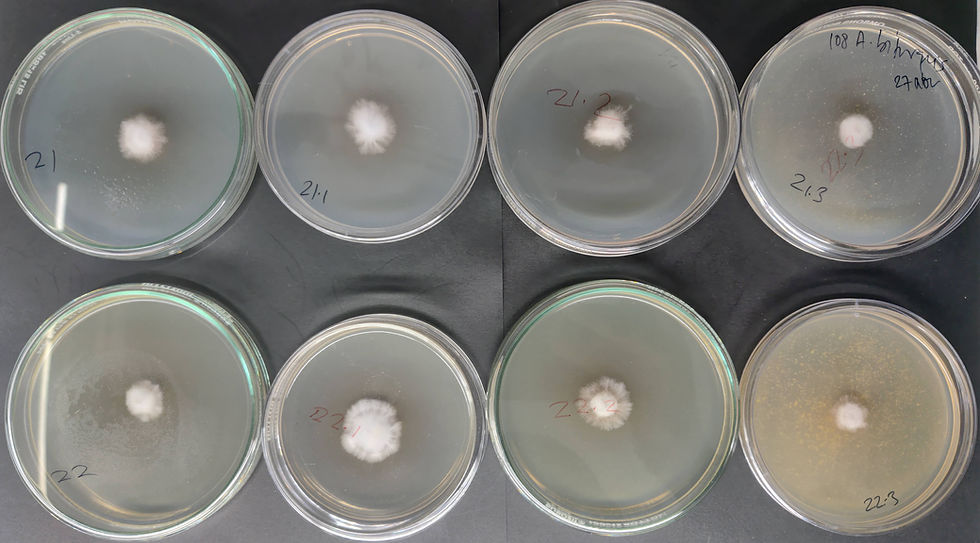

We tried obtaining a good colony growth of Agaricus bitorquis (summer button mushroom) on for 6-8 months but it not work well on previous culture media in our lab. Media 22.1 is an excellent media so far for this mushroom.
Observed Improvement in Growth Characteristics of Pholiota nameko (nameko mushroom)


WATER-colored mycelia of Pholiota nameko on agar plate is resolved with media 22.
Summary and Hopes
The fruiting protocol of Hericium erinaceus (Lion’s Mane mushroom) has now been successfully completed with the identification of a specific culture media component that induces early primordia formation on sawdust-based substrates, while simultaneously enhancing overall growth performance. This finding represents a meaningful advancement toward more predictable, efficient, and scalable cultivation of Lion’s Mane mushrooms.
In addition, improved growth characteristics were also observed in Agaricus bitorquis (summer button mushroom), Cordyceps militaris (Keeda jadi mushroom), and Pholiota nameko (Nameko mushroom), indicating the broader applicability of the optimized media strategy across diverse fungal taxa.
Collectively, these outcomes reinforce the potential of systematic culture media optimization as a powerful tool for accelerating mushroom domestication, improving yield stability, and supporting the expansion of sustainable mushroom cultivation technologies in both research and commercial settings.


Comments